Wildflower Doodles Font Review for Brand Designers
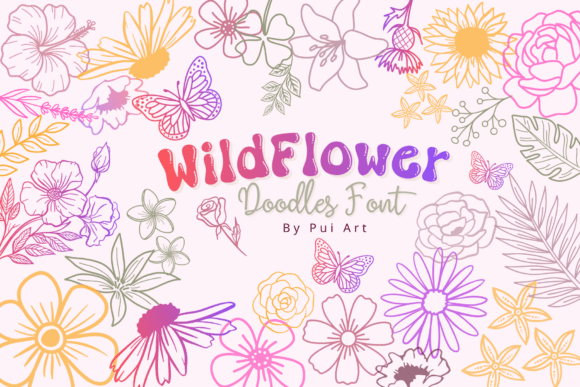
When I first loaded Wildflower Doodles into my design software, I was working on a visual refresh for a small-batch skincare line that wanted to move away from sterile minimalism. The client asked for something that felt organic, unpolished, and deeply connected to nature. As I scrolled through my library of Fonts, most options felt either too rigid or overly decorative in a way that sacrificed clarity. Then I opened the character map for this specific set of Dingbats, and the mood shifted immediately. Wildflower Doodles is a charming collection of hand-drawn floral doodles inspired by blooming meadows, cottage gardens, and natural botanical beauty. This versatile dingbat font features a delightful array of botanical elements that feel less like digital clipart and more like sketches from a field journal.
Integrating Wildflower Doodles into Logo Concepts and Brand Identity
In the early stages of that skincare project, I needed a logo mark that could stand alone without relying heavily on typography. I tested Wildflower Doodles by placing a few of the larger floral motifs next to a clean sans serif wordmark. The result was instantaneous balance. Unlike many standard Fonts that require extensive tweaking to look unique, these Dingbats brought immediate personality. The hand-drawn lines have a slight irregularity that mimics real ink on paper, which adds a layer of authenticity to the brand identity. For designers building a boutique identity, this font serves as an excellent accent tool. It allows you to create a custom icon system without hiring an illustrator, provided you respect the organic style. The key is to treat each doodle as a distinct graphic element rather than just a letter replacement.
Using Wildflower Doodles for Packaging Design and Product Labels
Packaging design demands attention to detail, especially when space is limited. I applied Wildflower Doodles to a mockup for a lavender balm jar. The smaller floral elements worked perfectly as border accents around the label edges, framing the product information without overwhelming it. Because Wildflower Doodles is a charming collection of hand-drawn floral doodles inspired by blooming meadows, cottage gardens, and natural botanical beauty. This versatile dingbat font features a delightful range of sizes, I could mix large statement flowers with tiny buds to create visual hierarchy. When using these Dingbats on physical products, contrast is crucial. I found that printing them in a muted sage green against a cream background looked far more sophisticated than stark black on white. This approach elevates the perceived value of the packaging, making it feel like a premium, handmade item rather than a mass-produced commodity. For any creative studio handling product launches, this font offers a quick way to add bespoke detailing.
Elevating Social Media Graphics and Web Design Headers
Digital spaces often feel cold, but Wildflower Doodles brings warmth to screens. I used the font in a series of Instagram posts for a local bakery rebrand. Instead of using stock photos for every post, I created simple graphic layouts using the floral Dingbats as corner decorations and dividers. The hand-drawn aesthetic stops the scroll because it feels human-made in a feed full of polished corporate content. In web design, I placed a cluster of these flowers in the hero section of a landing page. They acted as subtle visual anchors that guided the eye toward the call-to-action button. While Fonts are typically used for reading, this collection functions as structural art. It breaks up text blocks and adds breathing room to layouts. However, designers should be mindful of file size and rendering. Since these are vector-based glyphs, they scale infinitely without pixelation, ensuring crisp visuals on high-resolution displays and mobile devices alike.
Pairing Wildflower Doodles with Serif and Sans Serif Typefaces
A common mistake with decorative Dingbats is pairing them with equally busy typography. To let Wildflower Doodles shine, I paired it with a classic serif font for headings and a neutral sans serif for body copy. The contrast between the structured letters and the free-flowing floral shapes creates a dynamic tension that keeps the viewer engaged. For example, using a bold serif for a headline like "Spring Collection" alongside a delicate vine from Wildflower Doodles creates a balanced composition. The serif provides authority and readability, while the doodle adds emotion and context. Avoid pairing it with script fonts unless you are very careful, as the curves can compete and cause visual clutter. This font works best as a supporting actor, enhancing the message rather than shouting it. By keeping the accompanying Fonts simple, you ensure that the botanical beauty remains the focal point of the design asset.
Practical Limitations and Licensing Considerations for Commercial Use
While Wildflower Doodles is incredibly versatile, it is not a solution for every design problem. It is strictly a display and decorative resource. You cannot use it for long-form body text, legal disclaimers, or any application requiring high readability at small sizes. It is also not suitable for formal corporate environments where precision and neutrality are required. Before finalizing any client work, always test the font in its intended medium. Print a sample label, view the web header on a phone, and check how the Dingbats render in different colors. Additionally, always review the commercial font licensing agreement. Ensure that your intended use—whether for merchandise, digital products, or client branding—is covered. Understanding the scope of the license protects both you and your client from legal issues. When used correctly, Wildflower Doodles is a charming collection of hand-drawn floral doodles inspired by blooming meadows, cottage gardens, and natural botanical beauty. This versatile dingbat font features a delightful capability to transform ordinary layouts into memorable brand experiences.